Collect
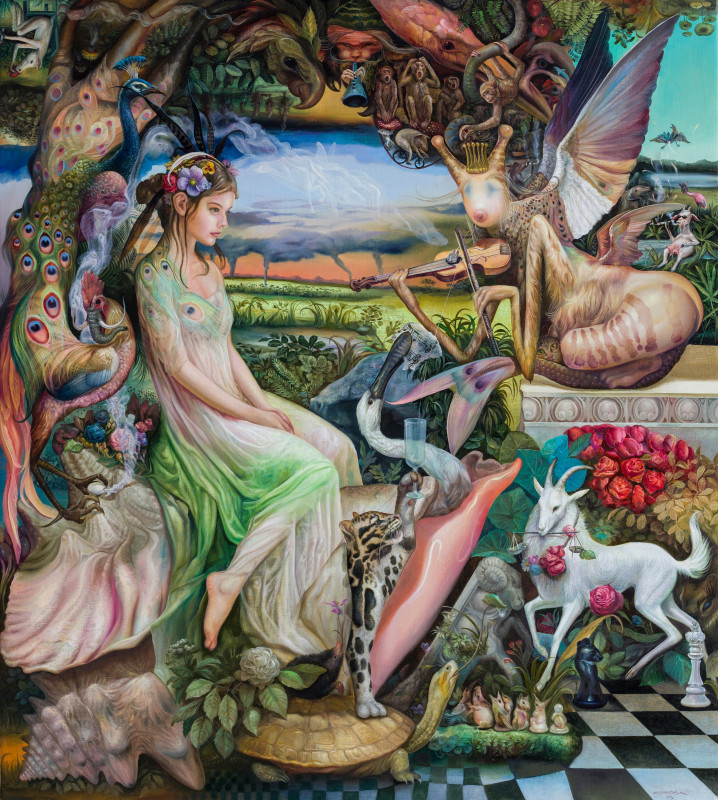
Violinist (Mother Nature)
Painting
Size 117cmX113.5cm
NTD 509,250 (USD 16,011.08) (After Tax)
Certificate
M2026OOC000143PA
此資產證號(M2026OOC000143PA)為登錄憑證;著作權或授權內容以另行標示為準。

Artist
Reydel Espinosa
Creation Year
2025
Condition Status
Well
Supplier
POST WINGS
Introduction
"The Violinist" is a visual allegory filled with magical surrealism, where animals, humans, and a fantastical world intertwine to construct a profound philosophical narrative about life, nature, and existence.
The work inherits the artistic spirit of surrealism, greatly inspired by the creations of Max Ernst and Leonora Carrington, continuing their dreamlike vocabulary that merges nature, mythology, and symbolism. In this artwork, every character, every action, and every element symbolizes the sacred and intimate interdependence between nature and humanity, inviting viewers to rethink our values, civilizational choices, and the world we will leave for future generations.
The main character possesses female breasts, a fish tail, and bird wings, symbolizing the fusion of maternity, aquatic life, and the freedom of flight. Holding a violin that symbolizes harmony, she embodies the "Mother Nature," attempting to restore the increasingly unbalanced order of nature through music.
She nourishes Taiwan's endangered species with her milk, symbolizing nature’s selfless provision of life-giving nutrients. The milk not only represents the continuation of life but also serves as nature’s last gentle redemption, striving to nourish those lives that still have a chance of being saved.
The dolphin inside the violin symbolizes the fragile plight of marine creatures. Under the pressure of entertainment and human development, their fate depends on whether nature and civilization can maintain balance. The Taiwan clouded leopard, a species long extinct from the mountains, is being nurtured by milk, forming a powerful philosophical metaphor: even when life is on the brink of extinction, hope is still worth protecting. The vessel in front of it resembles a holy grail of life, and the act of drinking milk appears as a silent plea for help. Thus, the work presents humanity with a fundamental question: as the dominant species on Earth, do we choose to nurture life or to take it away?
The endangered black-faced spoonbill holds the sheet music of Vivaldi's "Spring," playing a melody of rebirth alongside the violinist. However, the sheet music has been reduced to a single page, symbolizing the increasingly faint voice of nature that is almost inaudible. This is an urgent call: before humanity completely loses the melody of nature, let us listen to its voice again.
A pure white and mysterious goat carries a scale, presenting a heart-stirring question to the viewer: which is more valuable, money or wildlife? On either side of the scale are banknotes and green leaves, symbolizing fictional economic value versus the true value of life. The balance remains maintained, signifying that humanity still has the opportunity to choose.
The endemic and endangered snake-eating turtle carries a branch with a droplet of water hanging from it. That droplet symbolizes the purest essence of life and the resilience of life, while also reminding us that life is currently on the extremely fragile edge. It tells us that even a small action can be the key to either safeguarding life or destroying it.
A barefoot woman draped in peacock feathers symbolizes the still-sensitive human consciousness not yet lost. She gazes gently at the violinist, calling upon people to rediscover their sensitivity, empathy, and reverence for nature, and to re-establish the long-lost harmony between humanity and all beings.
At the bottom of the image is a chessboard, like a game that has lasted for millennia. The chessboard symbolizes the extremely fragile balance between human civilization and endangered species, suggesting that each choice made will determine the future of life. The chess piece representing the Formosan black bear is constrained by the rules of the game, reflecting the reality of their habitat increasingly shrinking due to human expansion.
The chessboard reminds us that the life on Earth is not a game that can be played from the sidelines, but a shared fate without spectators, only participants. Will humanity drive the Formosan black bear to extinction, or will we be able to take the final step to change the outcome?
"The Violinist" hopes to awaken viewers' deep thinking about nature, ecology, and bioethics through its dreamlike visual language. Just as every note in music influences the entire piece, every choice humanity makes today is composing the future fate of the Earth.
I hope to preserve those lives that may ultimately vanish through the canvas, so that future generations can still remember their existence. I also aspire for art to become a force that safeguards nature, inspiring more people to cherish and protect the lives that still inhabit this land.
The work inherits the artistic spirit of surrealism, greatly inspired by the creations of Max Ernst and Leonora Carrington, continuing their dreamlike vocabulary that merges nature, mythology, and symbolism. In this artwork, every character, every action, and every element symbolizes the sacred and intimate interdependence between nature and humanity, inviting viewers to rethink our values, civilizational choices, and the world we will leave for future generations.
The main character possesses female breasts, a fish tail, and bird wings, symbolizing the fusion of maternity, aquatic life, and the freedom of flight. Holding a violin that symbolizes harmony, she embodies the "Mother Nature," attempting to restore the increasingly unbalanced order of nature through music.
She nourishes Taiwan's endangered species with her milk, symbolizing nature’s selfless provision of life-giving nutrients. The milk not only represents the continuation of life but also serves as nature’s last gentle redemption, striving to nourish those lives that still have a chance of being saved.
The dolphin inside the violin symbolizes the fragile plight of marine creatures. Under the pressure of entertainment and human development, their fate depends on whether nature and civilization can maintain balance. The Taiwan clouded leopard, a species long extinct from the mountains, is being nurtured by milk, forming a powerful philosophical metaphor: even when life is on the brink of extinction, hope is still worth protecting. The vessel in front of it resembles a holy grail of life, and the act of drinking milk appears as a silent plea for help. Thus, the work presents humanity with a fundamental question: as the dominant species on Earth, do we choose to nurture life or to take it away?
The endangered black-faced spoonbill holds the sheet music of Vivaldi's "Spring," playing a melody of rebirth alongside the violinist. However, the sheet music has been reduced to a single page, symbolizing the increasingly faint voice of nature that is almost inaudible. This is an urgent call: before humanity completely loses the melody of nature, let us listen to its voice again.
A pure white and mysterious goat carries a scale, presenting a heart-stirring question to the viewer: which is more valuable, money or wildlife? On either side of the scale are banknotes and green leaves, symbolizing fictional economic value versus the true value of life. The balance remains maintained, signifying that humanity still has the opportunity to choose.
The endemic and endangered snake-eating turtle carries a branch with a droplet of water hanging from it. That droplet symbolizes the purest essence of life and the resilience of life, while also reminding us that life is currently on the extremely fragile edge. It tells us that even a small action can be the key to either safeguarding life or destroying it.
A barefoot woman draped in peacock feathers symbolizes the still-sensitive human consciousness not yet lost. She gazes gently at the violinist, calling upon people to rediscover their sensitivity, empathy, and reverence for nature, and to re-establish the long-lost harmony between humanity and all beings.
At the bottom of the image is a chessboard, like a game that has lasted for millennia. The chessboard symbolizes the extremely fragile balance between human civilization and endangered species, suggesting that each choice made will determine the future of life. The chess piece representing the Formosan black bear is constrained by the rules of the game, reflecting the reality of their habitat increasingly shrinking due to human expansion.
The chessboard reminds us that the life on Earth is not a game that can be played from the sidelines, but a shared fate without spectators, only participants. Will humanity drive the Formosan black bear to extinction, or will we be able to take the final step to change the outcome?
"The Violinist" hopes to awaken viewers' deep thinking about nature, ecology, and bioethics through its dreamlike visual language. Just as every note in music influences the entire piece, every choice humanity makes today is composing the future fate of the Earth.
I hope to preserve those lives that may ultimately vanish through the canvas, so that future generations can still remember their existence. I also aspire for art to become a force that safeguards nature, inspiring more people to cherish and protect the lives that still inhabit this land.
Video Intro
None
Exhibition Resume