Collect
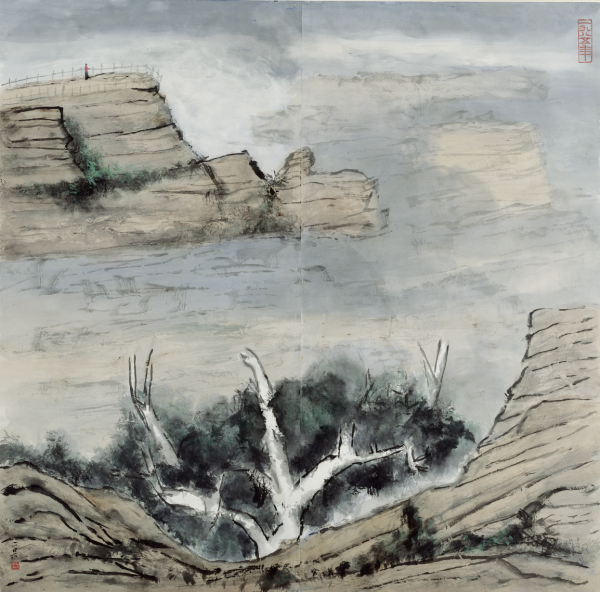
American Landscape
Color ink
Size 133.9cmx135.3cm
Certificate
M2026Colorink000002PA
此資產證號(M2026Colorink000002PA)為登錄憑證;著作權或授權內容以另行標示為準。

Artist
Chao Er Dai
Creation Year
1985
Condition Status
Well
Supplier
國立歷史博物館
Introduction
The painting depicts a desolate valley landscape. Layered rock walls are composed using loose and restrained brushwork; the lines do not deliberately seek intricate textures, but instead use simplified strokes to outline the structure of the rock layers, giving the mountains a texture reminiscent of geological faults.
At the valley's floor, a strikingly white branch of a dead tree extends outward, creating a strong contrast against the dark forest. The dead wood serves as both a trace of life that once existed and a mark of time left on the earth.
At the top of the scene, on the edge of a cliff, a very small figure stands beside a railing, gazing into the distance. This tiny red silhouette creates a distinct proportional relationship within the entire composition—man and nature, moment and time, life and the earth.
Zhao Erdai does not merely depict a landscape here but presents a sense of temporality and spirituality through concise brushwork. The contrast between the immense mountains and the minuscule figure not only portrays a natural scene but also serves as a metaphor about existence and observation.
Collection of the National Museum of History.
At the valley's floor, a strikingly white branch of a dead tree extends outward, creating a strong contrast against the dark forest. The dead wood serves as both a trace of life that once existed and a mark of time left on the earth.
At the top of the scene, on the edge of a cliff, a very small figure stands beside a railing, gazing into the distance. This tiny red silhouette creates a distinct proportional relationship within the entire composition—man and nature, moment and time, life and the earth.
Zhao Erdai does not merely depict a landscape here but presents a sense of temporality and spirituality through concise brushwork. The contrast between the immense mountains and the minuscule figure not only portrays a natural scene but also serves as a metaphor about existence and observation.
Collection of the National Museum of History.
Video Intro
None
Exhibition Resume