Collect
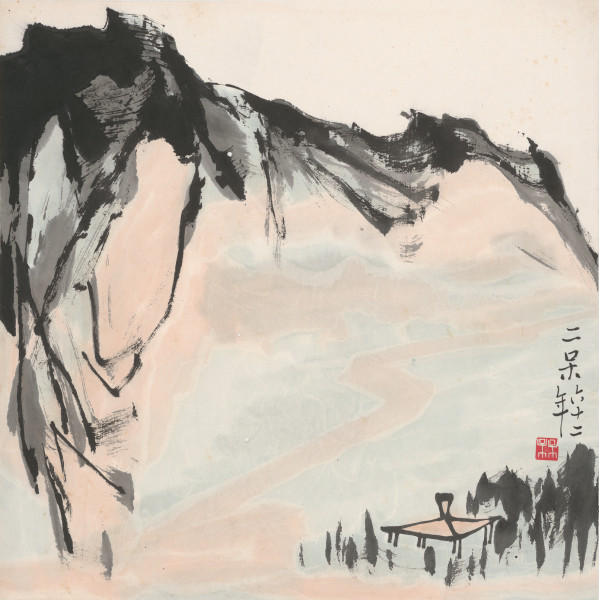
Viewing Waves Pavilion
Ink painting

Size 46.6cmX46.7cm
NTD 315,000 (USD 9,735.02) (After Tax)
Certificate
M2026CBP000002PA
此資產證號(M2026CBP000002PA)為登錄憑證;著作權或授權內容以另行標示為準。

Artist
Chao Er Dai
Creation Year
1973
Condition Status
Well
Supplier
POST WINGS
Introduction
This work features a dramatically sloped mountain range as the main subject of the painting. The mountain descends from the upper left, rendered in heavy ink with bold brushstrokes, creating a strong sense of oppression. In contrast, the lower right corner of the painting depicts a low building with minimal brushwork, intentionally scaled down, as if covered by the shadow of the mountain.
It is a resting pavilion—“Wave Under Rest Pavilion.” It does not symbolize permanence or settling down, but rather serves as a temporary stop. As the mountain range crashes down like waves, people do not disappear; instead, they find a space to rest beneath the shadow of the wave.
Zhao Erdai once again subverts the traditional order of viewing landscape painting: the mountains are not a realm for exploration but rather an unavoidable presence; the pavilion does not embellish the scenery but marks the short pause of humanity in the world. The mountains embody time and destiny, slow yet irresistible; the resting pavilion symbolizes a space where individuals, amidst pressure and fluctuations, still reserve a moment to catch their breath.
It is a resting pavilion—“Wave Under Rest Pavilion.” It does not symbolize permanence or settling down, but rather serves as a temporary stop. As the mountain range crashes down like waves, people do not disappear; instead, they find a space to rest beneath the shadow of the wave.
Zhao Erdai once again subverts the traditional order of viewing landscape painting: the mountains are not a realm for exploration but rather an unavoidable presence; the pavilion does not embellish the scenery but marks the short pause of humanity in the world. The mountains embody time and destiny, slow yet irresistible; the resting pavilion symbolizes a space where individuals, amidst pressure and fluctuations, still reserve a moment to catch their breath.
Video Intro
None
Exhibition Resume