Collect
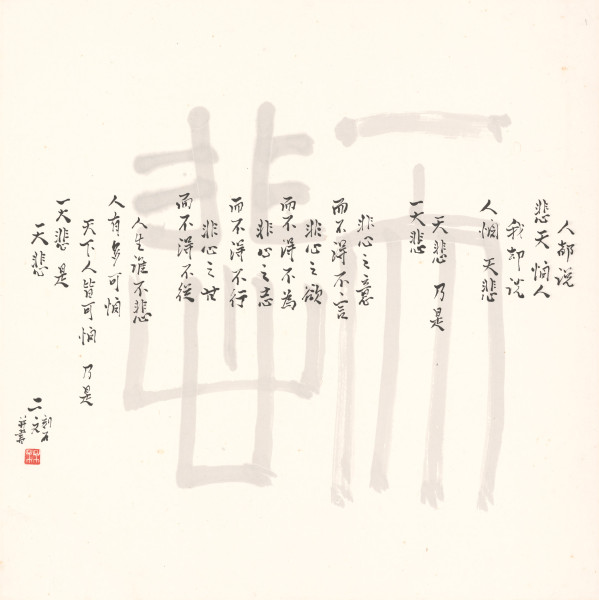
Heaven's Sadness
Calligraphy
Size 67.9cm×68cm
Price Not Set | Contact us to inquire about artwork status and collection availability
Certificate
M2025CGY000025PA
此資產證號(M2025CGY000025PA)為登錄憑證;著作權或授權內容以另行標示為準。

Artist
Chao Er Dai
Creation Year
約1989–90年
Condition Status
泛黃
Supplier
POST WINGS
Introduction
People often say: "Feel sorrow for the heavens, pity for humanity."
But I say:
"Humanity pities, the heavens grieve."
The heavens' grief is a great sorrow.
Not from the heart's intent,
Yet I cannot help but speak.
Not from the heart's desire,
Yet I cannot help but act.
Not from the heart's ambition,
Yet I cannot help but proceed.
Not from the heart's sweetness,
Yet I cannot help but follow.
Who in life is not sorrowful?
How pitiful can humanity be?
All people in the world are pitiable,
And that is a great sorrow.
It is the grief of the heavens.
In "Grief of the Heavens," Zhao Erdai presents not a religious pity, but an almost existential gaze. The "grief of the heavens" he speaks of does not imply that the heavens possess emotions; rather, he points out that the workings of nature and the universe inherently lack the ethics and compassion expected by humans.
This understanding of the world, rational yet unsparing, resonates profoundly with the Western philosopher Schopenhauer’s notion of "the world as will and representation."
The sorrow felt by humanity in the universe is not due to the world's cruelty, but rather because the world is indifferent to the concepts of cruelty or kindness.
"Grief of the Heavens" is not an accusation against the world, but rather an acknowledgment of its essence.
Heaven and earth are devoid of sentiment, yet humanity has feelings;
Sorrow arises precisely because of this.
But I say:
"Humanity pities, the heavens grieve."
The heavens' grief is a great sorrow.
Not from the heart's intent,
Yet I cannot help but speak.
Not from the heart's desire,
Yet I cannot help but act.
Not from the heart's ambition,
Yet I cannot help but proceed.
Not from the heart's sweetness,
Yet I cannot help but follow.
Who in life is not sorrowful?
How pitiful can humanity be?
All people in the world are pitiable,
And that is a great sorrow.
It is the grief of the heavens.
In "Grief of the Heavens," Zhao Erdai presents not a religious pity, but an almost existential gaze. The "grief of the heavens" he speaks of does not imply that the heavens possess emotions; rather, he points out that the workings of nature and the universe inherently lack the ethics and compassion expected by humans.
This understanding of the world, rational yet unsparing, resonates profoundly with the Western philosopher Schopenhauer’s notion of "the world as will and representation."
The sorrow felt by humanity in the universe is not due to the world's cruelty, but rather because the world is indifferent to the concepts of cruelty or kindness.
"Grief of the Heavens" is not an accusation against the world, but rather an acknowledgment of its essence.
Heaven and earth are devoid of sentiment, yet humanity has feelings;
Sorrow arises precisely because of this.
Video Intro
None
Exhibition Resume