Collect
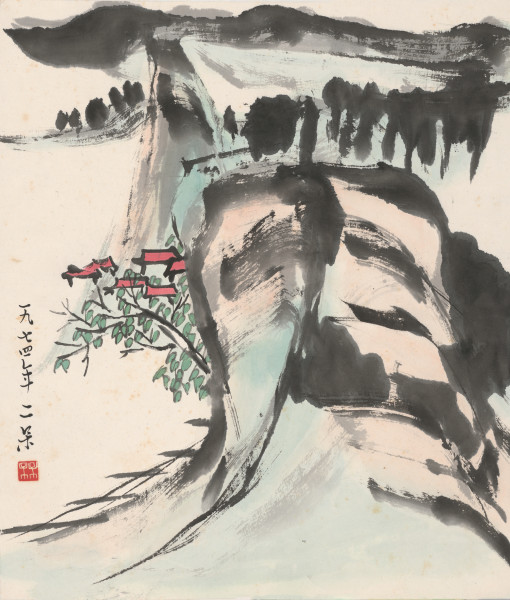
Red Roofs in the Hills
Ink painting

Size 45.4cmX53.4cm
Certificate
M2025CBP000115PA
此資產證號(M2025CBP000115PA)為登錄憑證;著作權或授權內容以另行標示為準。

Artist
Chao Er Dai
Creation Year
1974
Condition Status
Well
Supplier
POST WINGS
Introduction
This piece features layers of mountains as the main subject, with the rugged terrain appearing both substantial and fluid. The interplay of ink creates a strong rhythmic geography between compression and expansion. In the center of the composition, a mountain body slopes down like a precipice, dividing the space into two distinct worlds. In contrast, the left side is marked by just a few strokes of red roofs indicating human habitation, which, though minuscule in proportion, stands out remarkably against the dark mountains.
Zhao Er-Dai does not depict specific settlements; instead, he allows the red eaves to serve as a "marker of human existence within nature"—not in opposition to the mountainous terrain, but embedded within it. The mountains are not a conquerable entity but a long-lasting structure; human dwellings are like temporary nodes, quietly attached to it. This treatment reflects the artist's sober understanding of the relationship between nature and life in his later years: not occupying a dominant position, nor retreating, but finding a place that belongs to oneself amidst the mountain's presence.
Zhao Er-Dai does not depict specific settlements; instead, he allows the red eaves to serve as a "marker of human existence within nature"—not in opposition to the mountainous terrain, but embedded within it. The mountains are not a conquerable entity but a long-lasting structure; human dwellings are like temporary nodes, quietly attached to it. This treatment reflects the artist's sober understanding of the relationship between nature and life in his later years: not occupying a dominant position, nor retreating, but finding a place that belongs to oneself amidst the mountain's presence.
Video Intro
None
Exhibition Resume