Collect
Blooming
Ink painting
Size 46.1cm×52.5cm
NTD 315,000 (USD 9,859.19) (After Tax)
Certificate
M2025CBP000098PA
此資產證號(M2025CBP000098PA)為登錄憑證;著作權或授權內容以另行標示為準。

Artist
Chao Er Dai
Creation Year
1974
Condition Status
Well
Supplier
POST WINGS
Introduction
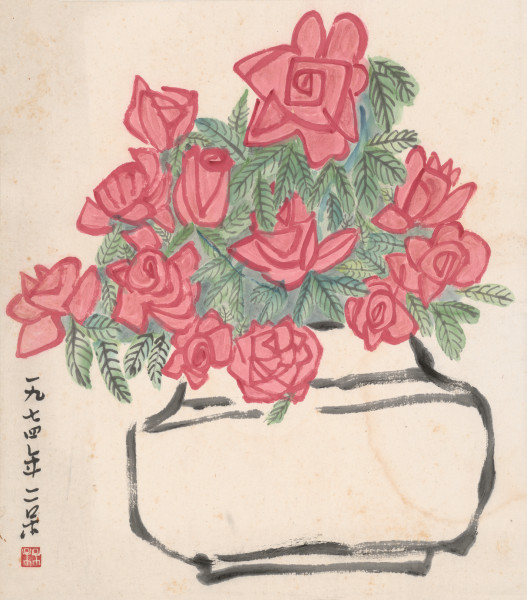
This work is themed around a potted red flower, yet it deliberately avoids the lyrical, vibrant, or symbolic narratives commonly associated with flowers. The flowers in the painting reappear in simplified geometric contours, layered upon one another, but do not seek perspective or spatial depth, presenting a flattened, almost static state of existence. The red is not used to evoke passion; instead, it is restrainedly placed over the blank spaces, forming a quiet and introspective rhythm through moderation. The pot at the bottom is outlined with rough strokes, appearing almost casual, which highlights the "presence" of the flowers themselves, naturally drawing the gaze to the clusters of red.
The twelve red flowers—rounded shapes resembling roses—are not arranged as a random quantity. Twelve, in a traditional context, implies completeness and wholeness, symbolizing the cyclical nature of time. This "completeness" does not denote a flamboyant happiness, but rather a stable, certain internal state. When contrasted with Zhao Erdai's life stage at the time, this work can be viewed as a portrayal of a very stable and happy period in his life—emotions rooted, life settled, and creativity growing naturally in balance.
The twelve red flowers—rounded shapes resembling roses—are not arranged as a random quantity. Twelve, in a traditional context, implies completeness and wholeness, symbolizing the cyclical nature of time. This "completeness" does not denote a flamboyant happiness, but rather a stable, certain internal state. When contrasted with Zhao Erdai's life stage at the time, this work can be viewed as a portrayal of a very stable and happy period in his life—emotions rooted, life settled, and creativity growing naturally in balance.
Video Intro
None
Exhibition Resume