Collect
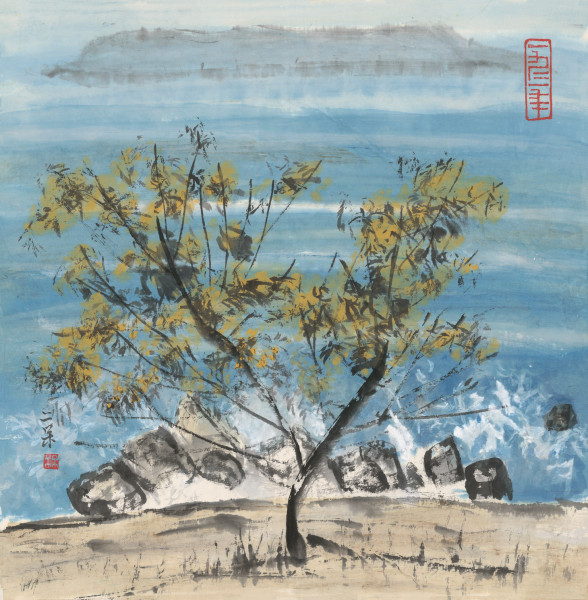
Basalt Coast
Ink painting
Size 68.4cm×69.7cm
Price Not Set | Contact us to inquire about artwork status and collection availability
Certificate
M2025CBP000086PA
此資產證號(M2025CBP000086PA)為登錄憑證;著作權或授權內容以另行標示為準。

Artist
Chao Er Dai
Creation Year
1988
Condition Status
泛黃
Supplier
POST WINGS
Introduction
The scene is set in the coastal area of Penghu, with a view of the basalt coastline in the distance and waves crashing against the shore. In the foreground stands a coastal tree growing in poor soil.
In Zhao Er-dai's work, ink painting is not a symbolic tool for conveying inner emotions, but rather a way of responding to the reality of the environment. His practice of "sketching" is not a meticulous depiction of outer forms, but an experiential way of observing—where the artist immerses himself in nature, painting amidst the wind direction, humidity, terrain, and visual distance, allowing the composition to naturally emerge from the on-site conditions.
The branches of the tree in the painting are tilted, and the leaves are fragmented and responding to the wind; they have not been idealized or organized into stable forms, but retain the state of growth under the strong coastal winds and salt mist environment. This asymmetrical and somewhat transient structure is the result of natural conditions directly entering the brushstrokes rather than a product of meta-composition.
The overall image presents an important characteristic of Zhao Er-dai's "sketching with ink": nature is not merely an object of lyrical expression but a co-creator of the conditions for the formation of the artwork alongside the viewer. This piece also indicates a shift in his ink painting from the traditional concept of landscape to a way of seeing grounded in bodily experience and real landscapes, becoming a crucial starting point for his subsequent visual vocabulary, such as “Lone Tree,” “Coastal,” and “Standing Against the Wind.”
In Zhao Er-dai's work, ink painting is not a symbolic tool for conveying inner emotions, but rather a way of responding to the reality of the environment. His practice of "sketching" is not a meticulous depiction of outer forms, but an experiential way of observing—where the artist immerses himself in nature, painting amidst the wind direction, humidity, terrain, and visual distance, allowing the composition to naturally emerge from the on-site conditions.
The branches of the tree in the painting are tilted, and the leaves are fragmented and responding to the wind; they have not been idealized or organized into stable forms, but retain the state of growth under the strong coastal winds and salt mist environment. This asymmetrical and somewhat transient structure is the result of natural conditions directly entering the brushstrokes rather than a product of meta-composition.
The overall image presents an important characteristic of Zhao Er-dai's "sketching with ink": nature is not merely an object of lyrical expression but a co-creator of the conditions for the formation of the artwork alongside the viewer. This piece also indicates a shift in his ink painting from the traditional concept of landscape to a way of seeing grounded in bodily experience and real landscapes, becoming a crucial starting point for his subsequent visual vocabulary, such as “Lone Tree,” “Coastal,” and “Standing Against the Wind.”
Video Intro
None
Exhibition Resume