Collect
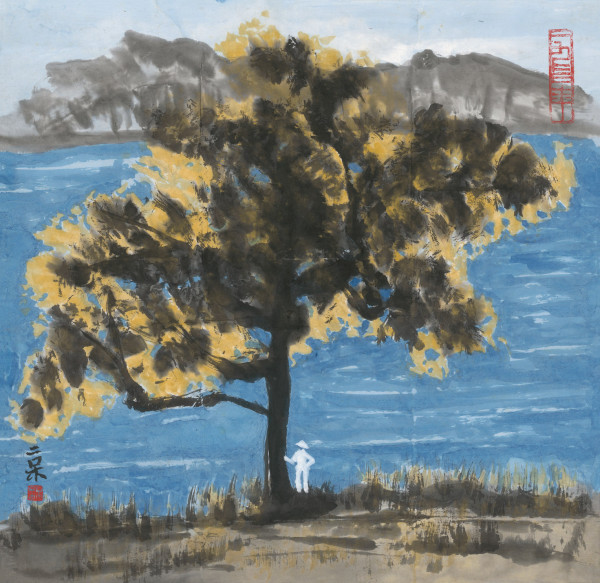
Shade of a Tree
Ink painting
Size 70.2cm×68.1 cm
Price Not Set | Contact us to inquire about artwork status and collection availability
Certificate
M2025CBP000085PA
此資產證號(M2025CBP000085PA)為登錄憑證;著作權或授權內容以另行標示為準。

Artist
Chao Er Dai
Creation Year
1979
Condition Status
泛黃
Supplier
POST WINGS
Introduction
This work was completed when Zhao Erdai was sixty-two years old, marking a critical stage in the formation of his personal ink wash style and narrative vocabulary. At this point, his creations have clearly departed from the traditional viewing logic aimed at the reproduction of landscapes, no longer adhering to the idealized space of "the mind precedes, composition follows," but instead turning to a continuous exploration of "how humans exist within nature."
In Zhao Erdai's creations, ink wash is no longer a vehicle for emotion or symbolism but rather a way of seeing that responds to the real environment. He has developed a form of "field sketch ink wash" that truly enters nature, grounded in bodily experience—not merely an outline reproduction, but a situational observation that allows the composition to naturally emerge from on-site conditions such as wind direction, terrain, perspective, and pathways.
As a result, the painting presents an atypical landscape structure: the mountains do not follow the traditional laws of perspective, the trees lean, and their growth directions are unstable, maintaining the asymmetry and temporality of on-site observation in spatial relationships. These are not formal deviations but rather the result of the natural state directly entering the brushwork.
The image depicts a gigantic tree on the coast, under which stands a common person wearing a conical hat. The figure is presented in a highly abstract silhouette, not set as the narrative subject but rather forming a balanced relationship with the land, wind, and sea. This approach signals the emergence of Zhao Erdai's early "non-heroic perspective"—the figure does not carry moral symbolism but exists merely as a state of being in nature.
This work can be seen as an important starting point in Zhao Erdai's ink wash narrative system: humans no longer dominate the scene but are enveloped by nature; the narrative is not driven by events but unfolds from existence itself, laying a crucial foundation for the core vocabulary of "common figures," "trees," and "isolated existence" that will repeatedly appear in his future works.
In Zhao Erdai's creations, ink wash is no longer a vehicle for emotion or symbolism but rather a way of seeing that responds to the real environment. He has developed a form of "field sketch ink wash" that truly enters nature, grounded in bodily experience—not merely an outline reproduction, but a situational observation that allows the composition to naturally emerge from on-site conditions such as wind direction, terrain, perspective, and pathways.
As a result, the painting presents an atypical landscape structure: the mountains do not follow the traditional laws of perspective, the trees lean, and their growth directions are unstable, maintaining the asymmetry and temporality of on-site observation in spatial relationships. These are not formal deviations but rather the result of the natural state directly entering the brushwork.
The image depicts a gigantic tree on the coast, under which stands a common person wearing a conical hat. The figure is presented in a highly abstract silhouette, not set as the narrative subject but rather forming a balanced relationship with the land, wind, and sea. This approach signals the emergence of Zhao Erdai's early "non-heroic perspective"—the figure does not carry moral symbolism but exists merely as a state of being in nature.
This work can be seen as an important starting point in Zhao Erdai's ink wash narrative system: humans no longer dominate the scene but are enveloped by nature; the narrative is not driven by events but unfolds from existence itself, laying a crucial foundation for the core vocabulary of "common figures," "trees," and "isolated existence" that will repeatedly appear in his future works.
Video Intro
None
Exhibition Resume