Collect
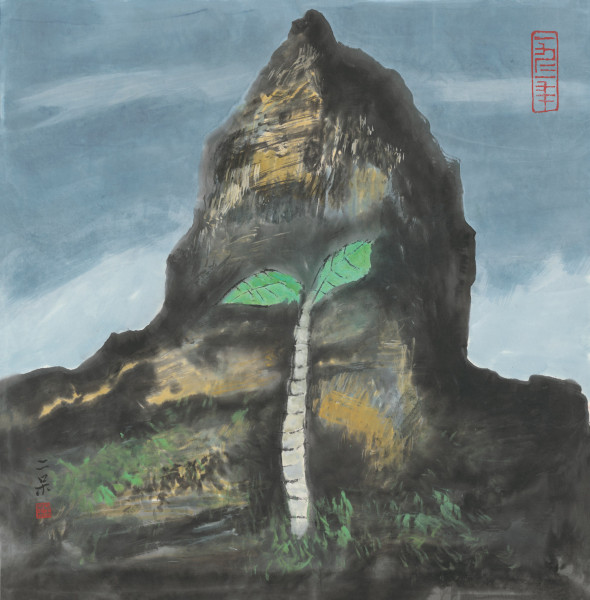
Heart of Life
Ink painting
Size 68.3cm×69.4 cm
Price Not Set | Contact us to inquire about artwork status and collection availability
Certificate
M2025CBP000084PA
此資產證號(M2025CBP000084PA)為登錄憑證;著作權或授權內容以另行標示為準。

Artist
Chao Er Dai
Creation Year
1979
Condition Status
泛黃
Supplier
POST WINGS
Introduction
This artwork depicts a life landscape that lies between natural realism and inner symbolism. In the foreground, a tree trunk emerges from barren soil, growing straight up, with branches and leaves unfolding, showing clearly the vein structure of the leaves. This demonstrates that it is not a fragile embellishment but a living being that is completing its own existence. Although the soil appears desolate, it does not hinder its growth; rather, it makes its presence more vivid.
In the background, a strangely shaped peak rises in isolation, its outline closed and concentrated, resembling organic forms, as if it reflects the plants in the foreground. The mountain does not serve as a backdrop but manifests as another kind of life—silent, heavy, and existing in solitude, yet complete in itself. The overall composition creates a visual overlap and counterbalance between the mountain and the plant, gradually merging into a complete image, as if the mountain itself is a massive, growing plant.
This approach embodies the recurring vocabulary in Zhao Er-Dai's works: the isolated image of life, completing oneself under adverse conditions, and existing independently from groups. The artist does not depict nature with realistic proportions but, through the transformation and reorganization of forms, allows the mountain, tree, and landscape to permeate each other, creating a visual state imbued with a magical realism. Nature here is no longer merely a scenery but an externalization of inner life states.
What "The Heart of Life" points to is not a romantic vision of nature but an affirmation of the essence of life—an acknowledgment that even in barren, isolated, and uncomprehended environments, life can still grow, stand, and complete itself in its own way.
In the background, a strangely shaped peak rises in isolation, its outline closed and concentrated, resembling organic forms, as if it reflects the plants in the foreground. The mountain does not serve as a backdrop but manifests as another kind of life—silent, heavy, and existing in solitude, yet complete in itself. The overall composition creates a visual overlap and counterbalance between the mountain and the plant, gradually merging into a complete image, as if the mountain itself is a massive, growing plant.
This approach embodies the recurring vocabulary in Zhao Er-Dai's works: the isolated image of life, completing oneself under adverse conditions, and existing independently from groups. The artist does not depict nature with realistic proportions but, through the transformation and reorganization of forms, allows the mountain, tree, and landscape to permeate each other, creating a visual state imbued with a magical realism. Nature here is no longer merely a scenery but an externalization of inner life states.
What "The Heart of Life" points to is not a romantic vision of nature but an affirmation of the essence of life—an acknowledgment that even in barren, isolated, and uncomprehended environments, life can still grow, stand, and complete itself in its own way.
Video Intro
None
Exhibition Resume