Collect
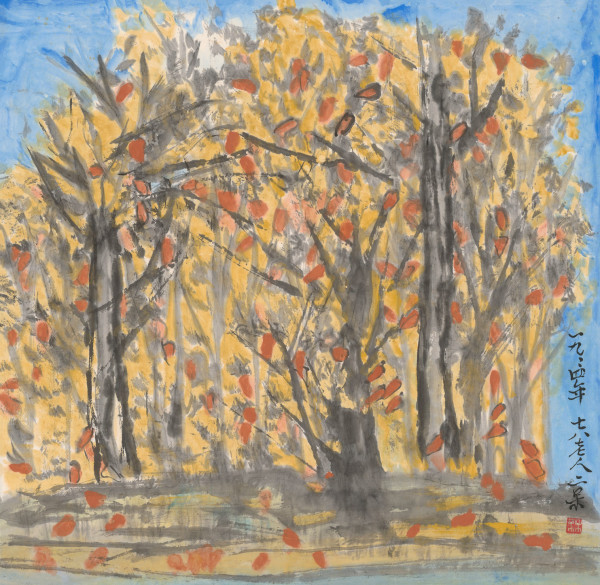
Autumn Forest Light and Shadow
Ink painting
Size 68cm×66.3cm
Price Not Set | Contact us to inquire about artwork status and collection availability
Certificate
M2025CBP000083PA
此資產證號(M2025CBP000083PA)為登錄憑證;著作權或授權內容以另行標示為準。

Artist
Chao Er Dai
Creation Year
1994
Condition Status
泛黃
Supplier
POST WINGS
Introduction
"Autumn Forest Light and Shadow" is a work from Zhao Erdai during his seventy-eight-year-old phase. The scene portrays groups of trees standing amidst a pervasive autumn atmosphere, with yellow leaves and orange-red hues interspersed. The branches have a soft and gentle stroke rather than a sharp edge. The fallen leaves swirl in the air, yet they do not convey desolation; instead, they present a warm, slow, and natural rhythm. This is not a lonely autumn scene, but a forest landscape filled with light and reflection.
Unlike Zhao Erdai's previous works that feature a calm critique of the world and repetitive writings on isolation, this piece no longer points towards questioning or confrontation. The fallen leaves here do not symbolize decay, but rather a return to one's roots; autumn does not signify an end, but a serene pause after a life journey has been completed. The scene does not depict lonely trees or solitary figures; the trees exist in groups, interconnected, indicating a shift in the artist's mindset from solitude to coexistence.
Crucially, Zhao Erdai personally inscribes "Seventy-eight Elder" at the signature location. This self-designation is not simply a marker of age, nor a melancholic self-reminder, but a clear and calm recognition of self—an acknowledgment of time and a retrospective acceptance of his life experiences. He no longer rushes to critique the state of the world nor attempts to argue for himself, but quietly stands within time, observing how life has arrived at this moment.
Unlike Zhao Erdai's previous works that feature a calm critique of the world and repetitive writings on isolation, this piece no longer points towards questioning or confrontation. The fallen leaves here do not symbolize decay, but rather a return to one's roots; autumn does not signify an end, but a serene pause after a life journey has been completed. The scene does not depict lonely trees or solitary figures; the trees exist in groups, interconnected, indicating a shift in the artist's mindset from solitude to coexistence.
Crucially, Zhao Erdai personally inscribes "Seventy-eight Elder" at the signature location. This self-designation is not simply a marker of age, nor a melancholic self-reminder, but a clear and calm recognition of self—an acknowledgment of time and a retrospective acceptance of his life experiences. He no longer rushes to critique the state of the world nor attempts to argue for himself, but quietly stands within time, observing how life has arrived at this moment.
Video Intro
None
Exhibition Resume