Collect
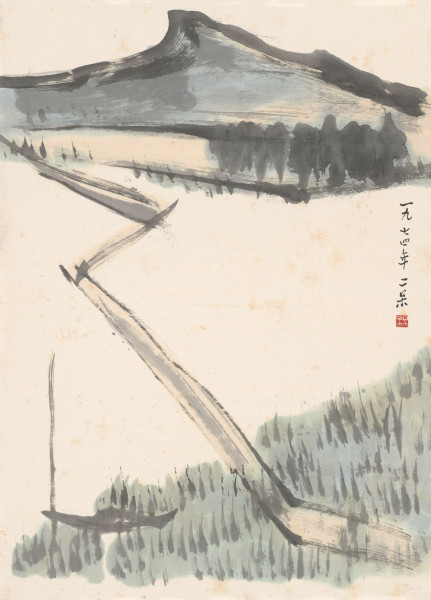
Pathway to Distant Mountains
Ink painting

Size 64.7cm×90cm
Certificate
M2025CBP000076PA
此資產證號(M2025CBP000076PA)為登錄憑證;著作權或授權內容以另行標示為準。

Artist
Chao Er Dai
Creation Year
1974
Condition Status
泛黃
Supplier
POST WINGS
Introduction
This work centers on a pathway that extends from the foreground into the background. In the foreground, there are boats moored at the shore, quietly resting, as if they have just arrived or have yet to embark. Starting from the boats, a wooden walkway winds its way up the terrain, twisting and extending until it ultimately disappears into the silhouettes of distant mountains and gray clouds. There are no pedestrians in the scene, nor is there a clear destination; only this path from the water to higher ground becomes the focal point for viewers.
Zhao Erdai does not depict "arrival," but rather focuses on the process of "moving from the mooring." The mountains are laid out with large washes of pale ink, creating a stable and expansive base; the wooden walkway, meanwhile, is rendered with diagonal, slender, and sharply cut lines that divide the spatial composition, allowing the gaze to shift between different levels. These lines not only constitute the path but also disrupt the stillness of the flat plane, introducing a sense of evident temporality and direction.
The overall composition adopts a bird's-eye view, observing from a height similar to that of a drone, which allows the boats in the foreground, the walkway in the middle ground, and the mountains in the background to be simultaneously encompassed in the view, presenting a vast and clear spatial order. Water and land, flatness and slant, stillness and movement are unified within the same frame.
Zhao Erdai does not depict "arrival," but rather focuses on the process of "moving from the mooring." The mountains are laid out with large washes of pale ink, creating a stable and expansive base; the wooden walkway, meanwhile, is rendered with diagonal, slender, and sharply cut lines that divide the spatial composition, allowing the gaze to shift between different levels. These lines not only constitute the path but also disrupt the stillness of the flat plane, introducing a sense of evident temporality and direction.
The overall composition adopts a bird's-eye view, observing from a height similar to that of a drone, which allows the boats in the foreground, the walkway in the middle ground, and the mountains in the background to be simultaneously encompassed in the view, presenting a vast and clear spatial order. Water and land, flatness and slant, stillness and movement are unified within the same frame.
Video Intro
None
Exhibition Resume