Collect
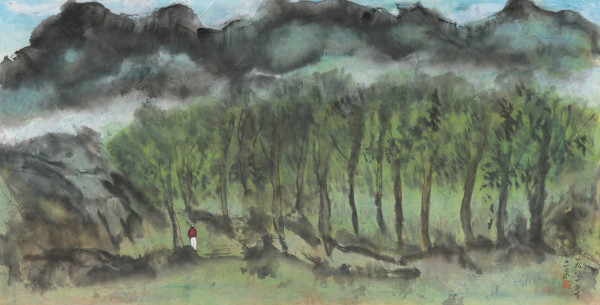
The Way of Contemplation
Ink painting
Size 134.2cm×68.1cm
Price Not Set | Contact us to inquire about artwork status and collection availability
Certificate
M2025CBP000075PA
此資產證號(M2025CBP000075PA)為登錄憑證;著作權或授權內容以另行標示為準。

Artist
Chao Er Dai
Creation Year
1982
Condition Status
泛黃
Supplier
POST WINGS
Introduction
This work depicts a forest scene in the mountains, with layers of peaks rising and falling in the mist, trees arranged in rows, and a vast, silent sky and earth. At the bottom of the painting, a small figure dressed in red stands alone on a forest path, its size dwarfed by the surrounding environment.
This red figure is a recurring self-symbol in Zhao Erdai's creations. The figure does not perform any actions or occupy the center of the composition, but rather adopts a near-observer posture, wandering through nature. The color red here is not ostentatious but represents a conscious awareness of existence—amidst the vastness of the universe, one may be small, yet still possess a clear understanding of one’s position.
The treatment of the mist in the painting causes the mountains and forests to lose their distinct boundaries. Nature is no longer an object to be grasped but a continuously flowing, indefinable realm of existence. Zhao Erdai does not deliberately portray the grandeur of the mountains; instead, through wet ink, light colors, and blurred brushstrokes, he creates a sense of uncertain spatiality that guides the viewer’s gaze into the experience of "walking within."
In this work, the human figure is no longer the subject of nature, nor a contrasting object against it, but merely a part of the whole. The smallness of the figure is not a diminishment, but a return—a return to the original state of being as a component of life.
This red figure is a recurring self-symbol in Zhao Erdai's creations. The figure does not perform any actions or occupy the center of the composition, but rather adopts a near-observer posture, wandering through nature. The color red here is not ostentatious but represents a conscious awareness of existence—amidst the vastness of the universe, one may be small, yet still possess a clear understanding of one’s position.
The treatment of the mist in the painting causes the mountains and forests to lose their distinct boundaries. Nature is no longer an object to be grasped but a continuously flowing, indefinable realm of existence. Zhao Erdai does not deliberately portray the grandeur of the mountains; instead, through wet ink, light colors, and blurred brushstrokes, he creates a sense of uncertain spatiality that guides the viewer’s gaze into the experience of "walking within."
In this work, the human figure is no longer the subject of nature, nor a contrasting object against it, but merely a part of the whole. The smallness of the figure is not a diminishment, but a return—a return to the original state of being as a component of life.
Video Intro
None
Exhibition Resume