Collect
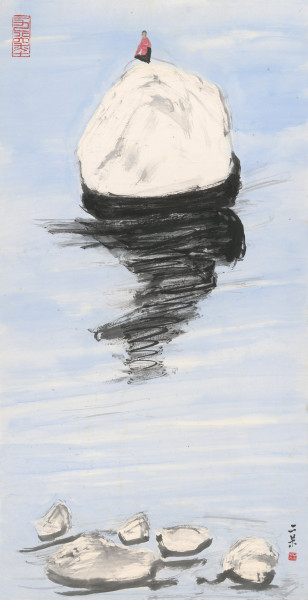
Sitting Alone on the Stone
Ink painting
Size 69.1cm×134.6cm
Price Not Set | Contact us to inquire about artwork status and collection availability
Certificate
M2025CBP000072PA
此資產證號(M2025CBP000072PA)為登錄憑證;著作權或授權內容以另行標示為準。

Artist
Chao Er Dai
Creation Year
1987
Condition Status
泛黃
Supplier
POST WINGS
Introduction
This work is composed of an extremely simplified and unusual spatial structure. In the center of the lake, a huge rock stands abruptly, with a figure dressed in red seated upon it; in the background, the figure appears tiny, contrasting sharply with the rock's enormity and isolation. In the foreground, a few small stones are scattered, allowing the viewer to infer the scale of the giant rock in the lake and to become aware of the remoteness and solitude of the figure's position.
The image does not depict the process of crossing the river, nor does it provide an identifiable path— the figure seems to have already arrived yet remains in a state of “not returning.” This deliberate interruption of the narrative transforms the work from a mere landscape depiction into a presentation of a state of existence.
The appearance of the figure in red does not signify a flamboyant emotional declaration, but rather a lingering inner warmth. Although the figure chooses to live in solitude, away from the shore and the world, they do not completely erase themselves; that splash of red suggests a continued expectation of understanding and response.
The figure in the painting is often seen as a projection of the artist himself. Zhao Erhai spent his life accustomed to solitude, characterized by pride and maintaining distance from the world; however, this distance is not a rejection but rather a high demand for the quality of relationships— a true confidant must be willing to cross the water, understand silence, and accept the passage of time.
The image does not depict the process of crossing the river, nor does it provide an identifiable path— the figure seems to have already arrived yet remains in a state of “not returning.” This deliberate interruption of the narrative transforms the work from a mere landscape depiction into a presentation of a state of existence.
The appearance of the figure in red does not signify a flamboyant emotional declaration, but rather a lingering inner warmth. Although the figure chooses to live in solitude, away from the shore and the world, they do not completely erase themselves; that splash of red suggests a continued expectation of understanding and response.
The figure in the painting is often seen as a projection of the artist himself. Zhao Erhai spent his life accustomed to solitude, characterized by pride and maintaining distance from the world; however, this distance is not a rejection but rather a high demand for the quality of relationships— a true confidant must be willing to cross the water, understand silence, and accept the passage of time.
Video Intro
None
Exhibition Resume