Collect
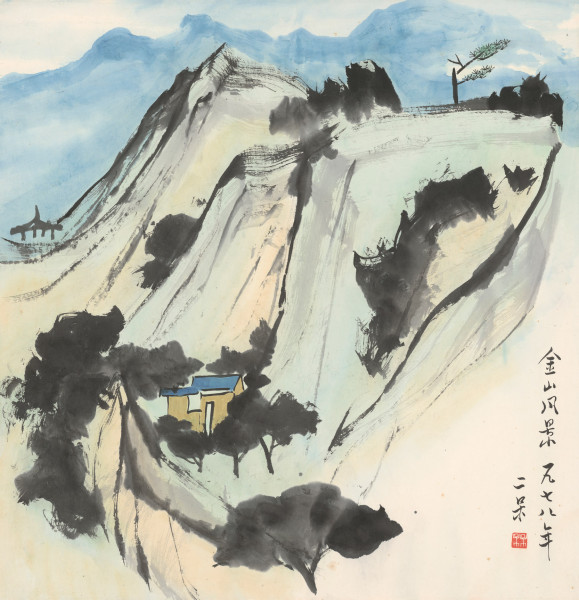
Realm of Golden Mountain
Ink painting

Size 66.6cmX69.1cm
NTD 367,500 (USD 11,502.38) (After Tax)
Certificate
M2025CBP000067PA
此資產證號(M2025CBP000067PA)為登錄憑證;著作權或授權內容以另行標示為準。

Artist
Chao Er Dai
Creation Year
1978
Condition Status
泛黃
Supplier
POST WINGS
Introduction
This work depicts the landscape of Jinshan from a mountaintop perspective. The scene shows the mountains cascading downward, with bold and slanted brushstrokes that reflect the terrain of the North Coast sculpted by years of wind. At the ridge's height, a solitary tree stands upright; its leaves are still green, yet the entire structure leans to the right, clearly responding to the northeast monsoon that blows year-round in the Jinshan area.
This isolated plant in the high ground is a recurring core symbol in Zhao Er-Dai's works. It does not cluster together nor does it grow in the valleys, but instead chooses to stand where the winds are strongest. The tree's inclination does not signify submission, but represents a posture of maintaining its vitality under natural conditions—thriving against the wind without breaking.
In terms of composition, the artist deliberately raises the viewpoint, making the viewer feel as if they are looking down from the mountaintop onto the human world. The mountains are depicted with sweeping strokes, while the houses merely serve as low-lying points in the scene, suggesting the insignificance and transience of human habitation; only the solitary tree at the height bears the spiritual weight of the entire painting with minimal brushwork.
The language of brush and ink continues Zhao Er-Dai's style of simple ink wash: the mountains and rocks do not seek complete rendering but emphasize the flow of spirit; the variations in ink density correspond to the direction and strength of the wind. There is no need to depict the wind itself in the painting; the tree's inclination is proof of the wind's presence.
This isolated plant in the high ground is a recurring core symbol in Zhao Er-Dai's works. It does not cluster together nor does it grow in the valleys, but instead chooses to stand where the winds are strongest. The tree's inclination does not signify submission, but represents a posture of maintaining its vitality under natural conditions—thriving against the wind without breaking.
In terms of composition, the artist deliberately raises the viewpoint, making the viewer feel as if they are looking down from the mountaintop onto the human world. The mountains are depicted with sweeping strokes, while the houses merely serve as low-lying points in the scene, suggesting the insignificance and transience of human habitation; only the solitary tree at the height bears the spiritual weight of the entire painting with minimal brushwork.
The language of brush and ink continues Zhao Er-Dai's style of simple ink wash: the mountains and rocks do not seek complete rendering but emphasize the flow of spirit; the variations in ink density correspond to the direction and strength of the wind. There is no need to depict the wind itself in the painting; the tree's inclination is proof of the wind's presence.
Video Intro
None
Exhibition Resume