Collect
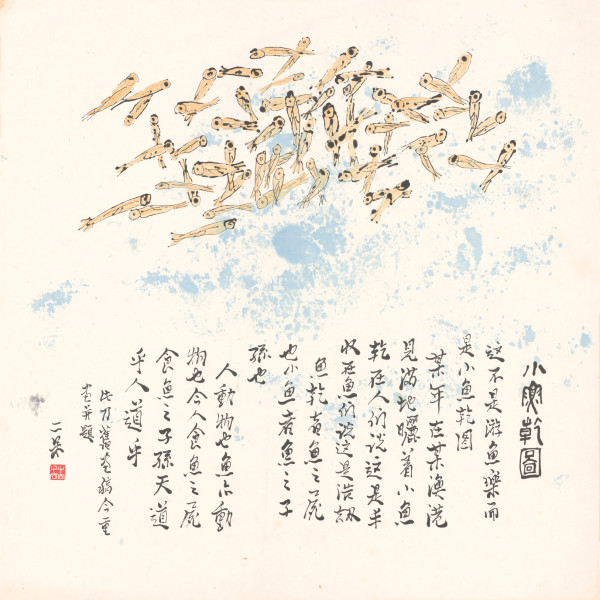
School of Small Fish
Ink painting
Size 67.9cmX67.9cm
Price Not Set | Contact us to inquire about artwork status and collection availability
Certificate
M2025CBP000066PA
此資產證號(M2025CBP000066PA)為登錄憑證;著作權或授權內容以另行標示為準。

Artist
Chao Er Dai
Creation Year
約1990年
Condition Status
Well
Supplier
POST WINGS
Introduction
This is not "The Joy of Swimming Fish," but rather "The Dried Fish Picture."
One year, at a certain fishing port, I saw the ground covered with dried fish. People called it a "bountiful harvest," using familiar and comforting language to name this scene. However, in the world of fish, this is a calamity. The dried fish are the corpses of the fish; the small fish are the descendants of the fish. Humans are animals too; fish are animals too.
Today, people eat the corpses of fish and the descendants of fish. Is this the way of heaven or the way of humanity?
One year, passing through a fishing port, the ground was laid with a multitude of small dried fish. People referred to it as a "bountiful harvest," naming this scene with language that provides a sense of comfort. Yet in the fish's world, this is a disaster.
In "The Dried Fish Picture," Zhao Erdai does not depict bloodshed or screams but instead adopts an extremely calm perspective to rename this scene that humans have grown accustomed to—dried fish are the corpses of fish; small fish are the descendants of fish. Here, language is no longer decorative but revealing. When "bountiful harvest" is dissected into corpses and the disappearance of descendants, the self-soothing language of humanity becomes exposed.
The work further pulls back to the fundamental conditions of existence: humans are animals too; fish are animals too. This is not a moral condemnation but a straightforward presentation of facts. Humans eat the corpses of fish and the descendants of fish—this behavior is rationalized, institutionalized, and normalized in human society, yet seldom reexamined in its ethical position.
Zhao Erdai's irony lies here. He does not deny the survival needs of humanity, nor does he demand redemption in a tragic pose. What he questions is the confidence of humans who, while engaging in large-scale plunder, still believe they stand on moral high ground. When violence is renamed as a bountiful harvest, and calamity is packaged as achievement, what humanity displays is not cruelty but a noble illusion of lacking reflection on its own actions.
One year, at a certain fishing port, I saw the ground covered with dried fish. People called it a "bountiful harvest," using familiar and comforting language to name this scene. However, in the world of fish, this is a calamity. The dried fish are the corpses of the fish; the small fish are the descendants of the fish. Humans are animals too; fish are animals too.
Today, people eat the corpses of fish and the descendants of fish. Is this the way of heaven or the way of humanity?
One year, passing through a fishing port, the ground was laid with a multitude of small dried fish. People referred to it as a "bountiful harvest," naming this scene with language that provides a sense of comfort. Yet in the fish's world, this is a disaster.
In "The Dried Fish Picture," Zhao Erdai does not depict bloodshed or screams but instead adopts an extremely calm perspective to rename this scene that humans have grown accustomed to—dried fish are the corpses of fish; small fish are the descendants of fish. Here, language is no longer decorative but revealing. When "bountiful harvest" is dissected into corpses and the disappearance of descendants, the self-soothing language of humanity becomes exposed.
The work further pulls back to the fundamental conditions of existence: humans are animals too; fish are animals too. This is not a moral condemnation but a straightforward presentation of facts. Humans eat the corpses of fish and the descendants of fish—this behavior is rationalized, institutionalized, and normalized in human society, yet seldom reexamined in its ethical position.
Zhao Erdai's irony lies here. He does not deny the survival needs of humanity, nor does he demand redemption in a tragic pose. What he questions is the confidence of humans who, while engaging in large-scale plunder, still believe they stand on moral high ground. When violence is renamed as a bountiful harvest, and calamity is packaged as achievement, what humanity displays is not cruelty but a noble illusion of lacking reflection on its own actions.
Video Intro
None
Exhibition Resume