Collect
Form. Structure
Ink painting
Size 68.3cmX68.8cm
NTD 367,500 (USD 11,502.38) (After Tax)
Certificate
M2025CBP000064PA
此資產證號(M2025CBP000064PA)為登錄憑證;著作權或授權內容以另行標示為準。

Artist
Chao Er Dai
Creation Year
1989
Condition Status
泛黃
Supplier
POST WINGS
Introduction
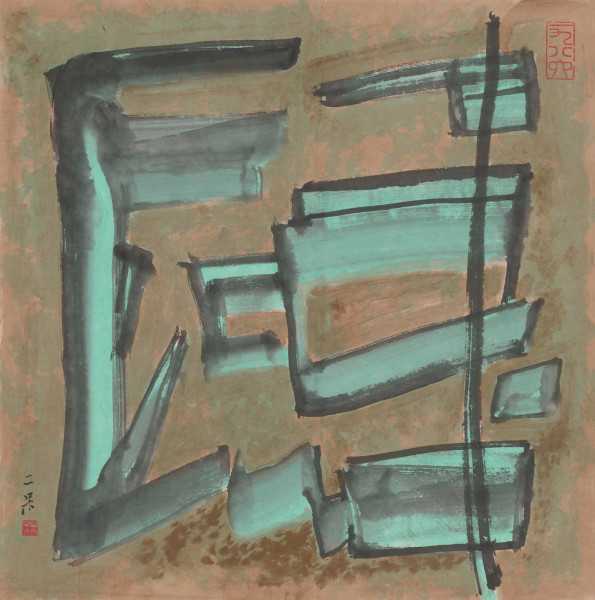
This work was completed during the late years of Zhao Erdai's time in Penghu and belongs to a series of structural translations of Eastern materials influenced by Western modern art, similar to "Cyclone Self-formation." Unlike the abstract compositions based on airflow, "Form. Structure" draws directly from seal script as its formal source, viewing writing as a structural issue that can be deconstructed and reorganized.
The strokes in the composition no longer adhere to the readability of the text or the traditional order of calligraphy; instead, they are regarded as form units possessing weight, direction, and spatial relationships. This approach clearly responds to the analytical methods of form structure in Western Cubism, liberating the "character" from flat writing and transforming it into an existence with spatiality and compositional tension.
However, this transformation is not a mere following of Western forms. Zhao Erdai still employs ink and the brushwork of writing as a generating method, allowing the forms to retain breath, speed, and corporeality. Here, the characters are neither language nor purely geometric; they are a "trace of existence" suspended between writing and composition.
The strokes in the composition no longer adhere to the readability of the text or the traditional order of calligraphy; instead, they are regarded as form units possessing weight, direction, and spatial relationships. This approach clearly responds to the analytical methods of form structure in Western Cubism, liberating the "character" from flat writing and transforming it into an existence with spatiality and compositional tension.
However, this transformation is not a mere following of Western forms. Zhao Erdai still employs ink and the brushwork of writing as a generating method, allowing the forms to retain breath, speed, and corporeality. Here, the characters are neither language nor purely geometric; they are a "trace of existence" suspended between writing and composition.
Video Intro
None
Exhibition Resume