Collect
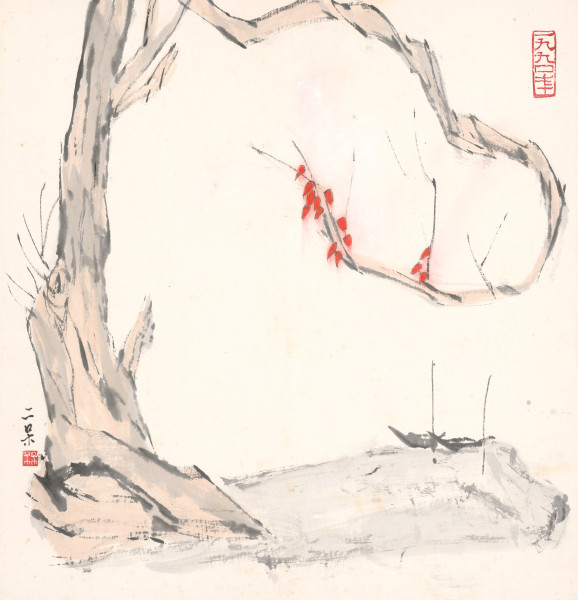
Rebirth
Ink painting
Size 65.6cm×68cm
Certificate
M2025CBP000063PA
此資產證號(M2025CBP000063PA)為登錄憑證;著作權或授權內容以另行標示為準。

Artist
Chao Er Dai
Creation Year
1990
Condition Status
泛黃
Supplier
POST WINGS
Introduction
The composition centers around a fragment of a withered branch, depicted with highly restrained ink lines, leaving much of the space blank. The uniquely curved shape of the dry branch spirals outward, its lines dry yet resilient, as if time has left its traces upon it. At the tip of the branch, tiny red flowers (or red leaves) emerge as small, concentrated dots of color—not as decoration nor as a symbolic emotional projection, but as a direct acknowledgment of a state of being: amidst aging and simplification, growth is still occurring. The dead and the living coexist on the same branch, illustrating the natural law of the cyclical nature of life: decay is not an end but a prelude to another form of generation.
In the distance, two small boats are faintly visible on the water's surface, rendered with just a few strokes, almost merging into the space around them. The boats no longer carry a specific narrative but serve as hints of scale and distance, symbolizing the idea of "going and returning"—capable of journeying afar as well as returning home. They rest upon the water's surface, not asserting a direction, yet implying choice and possibilities: life is not a one-way progression, but rather finding one's rhythm in the interplay of comings and goings. The branch is near, the boats are far, reflecting the generation of life and the ebb and flow of human existence within the same frame.
In the distance, two small boats are faintly visible on the water's surface, rendered with just a few strokes, almost merging into the space around them. The boats no longer carry a specific narrative but serve as hints of scale and distance, symbolizing the idea of "going and returning"—capable of journeying afar as well as returning home. They rest upon the water's surface, not asserting a direction, yet implying choice and possibilities: life is not a one-way progression, but rather finding one's rhythm in the interplay of comings and goings. The branch is near, the boats are far, reflecting the generation of life and the ebb and flow of human existence within the same frame.
Video Intro
None
Exhibition Resume