Collect
Cyclone Self-Formation
Ink painting
Size 66.9cm×69.3cm
NTD 367,500 (USD 11,502.38) (After Tax)
Certificate
M2025CBP000061PA
此資產證號(M2025CBP000061PA)為登錄憑證;著作權或授權內容以另行標示為準。

Artist
Chao Er Dai
Creation Year
1988
Condition Status
Well
Supplier
POST WINGS
Introduction
In his later years, Mr. Erdai underwent a profound shift in his artistic vocabulary, no longer relying on natural imagery or personal symbolism as the main carriers, but directly delving into the thoughts of "form and structure itself."
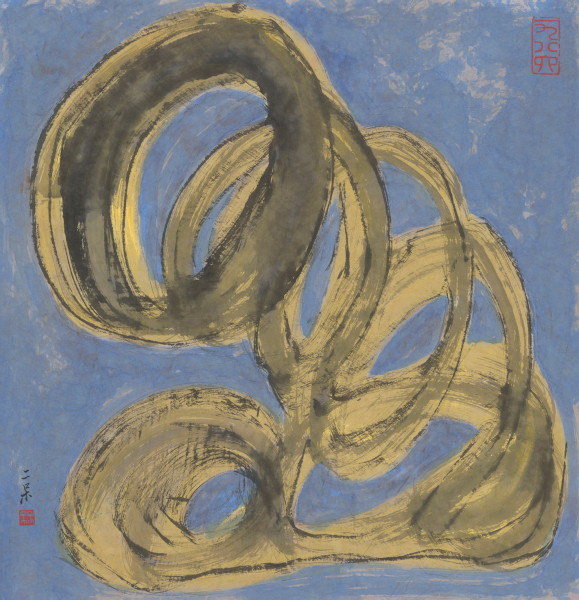
The composition is made up of multiple groups of circular, swirling brushstrokes that interweave and overlap, lacking any sense of foreground or background depth, and defying the traditional spatial logic of landscape painting. This compositional approach clearly responds to the focus on volume, abstraction, and dynamism in Western modern art, reflecting the artist's extensive exposure to Western art during this period, resulting in a structural consciousness shaped after Cubism and Abstract Art.
However, Zhao Erdai's focus extends beyond mere formal imitation. Using Eastern ink as his medium, he attempts to transform the so-called "qi yun" (the life flow that is invisible, untraceable, and can only be felt) into a "form of qi" that can be viewed. Here, the brushstrokes no longer serve to depict objects but become the very trajectory of energy: rotating, aggregating, shifting, and returning, as if leaving traces of air in space.
This method of handling gives the "qi" in the artwork a dual significance of both Eastern and Western contexts. In the East, it continues the pursuit of vivid "qi yun" in ink; in the West, it approaches a visualization of energy, movement, and structure.
The two are not simply juxtaposed; rather, they are unified within the same rhythmic brushstroke. The blue background further dissolves the figurative space, making the painting no longer point towards natural scenes but transform into a purely perceptual domain. The intertwining circular structures of gold and black possess both weight and fluidity, creating tension between stability and change, making the viewer feel as if they are within a dynamic "qi field."
"Qi Xuan Zicheng" is not merely a stylistic experiment; it is a mature and conscious translational action—Zhao Erdai responds to the inquiries of Western modern art regarding form and structure with the spiritual core of an Eastern artist, demonstrating that ink can not only carry landscapes and lyricism but also serve as a contemporary medium to contemplate "how qi exists."
The composition is made up of multiple groups of circular, swirling brushstrokes that interweave and overlap, lacking any sense of foreground or background depth, and defying the traditional spatial logic of landscape painting. This compositional approach clearly responds to the focus on volume, abstraction, and dynamism in Western modern art, reflecting the artist's extensive exposure to Western art during this period, resulting in a structural consciousness shaped after Cubism and Abstract Art.
However, Zhao Erdai's focus extends beyond mere formal imitation. Using Eastern ink as his medium, he attempts to transform the so-called "qi yun" (the life flow that is invisible, untraceable, and can only be felt) into a "form of qi" that can be viewed. Here, the brushstrokes no longer serve to depict objects but become the very trajectory of energy: rotating, aggregating, shifting, and returning, as if leaving traces of air in space.
This method of handling gives the "qi" in the artwork a dual significance of both Eastern and Western contexts. In the East, it continues the pursuit of vivid "qi yun" in ink; in the West, it approaches a visualization of energy, movement, and structure.
The two are not simply juxtaposed; rather, they are unified within the same rhythmic brushstroke. The blue background further dissolves the figurative space, making the painting no longer point towards natural scenes but transform into a purely perceptual domain. The intertwining circular structures of gold and black possess both weight and fluidity, creating tension between stability and change, making the viewer feel as if they are within a dynamic "qi field."
"Qi Xuan Zicheng" is not merely a stylistic experiment; it is a mature and conscious translational action—Zhao Erdai responds to the inquiries of Western modern art regarding form and structure with the spiritual core of an Eastern artist, demonstrating that ink can not only carry landscapes and lyricism but also serve as a contemporary medium to contemplate "how qi exists."
Video Intro
None
Exhibition Resume