Collect
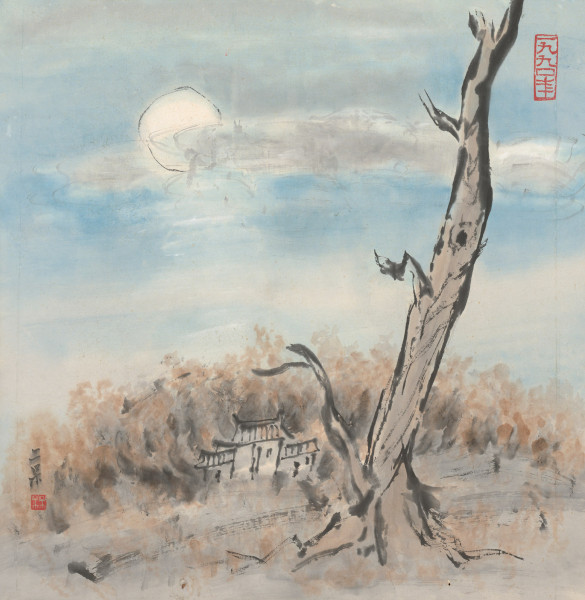
Lone Tree Looking at the Moon
Ink painting

Size 67.6cmX69.2cm
NTD 367,500 (USD 11,311.14) (After Tax)
Certificate
M2025CBP000052PA
此資產證號(M2025CBP000052PA)為登錄憑證;著作權或授權內容以另行標示為準。

Artist
Chao Er Dai
Creation Year
1990
Condition Status
泛黃/裸件
Supplier
POST WINGS
Introduction
This work was completed in the later years of Mr. Zhao Erdai after he settled in Penghu. The image features a uniquely shaped solitary tree as the main subject in the foreground, with its sturdy trunk and fractured branches standing amidst a winter forest. Its posture is neither exuberantly growing nor entirely withered, but rather represents a state of standing after enduring the passage of time.
In the middle ground, traditional old houses from Penghu can be vaguely seen among the trees, depicted with minimal brushwork, like remnants of memory. The houses do not take center stage; they merely symbolize time and existence—present, yet receding into the background, seemingly drifting apart from the artist himself. In the distant background, an empty space in the sky reveals a faint moon, which is not entirely full, yet is constantly present in the heavens.
In terms of composition, Zhao Erdai deliberately contrasts the strong verticality of the solitary tree with the horizontally extended landscape and sky, creating tension in the viewer's gaze within the painting. The solitary tree stands towards the moon, forming a silent relationship of gaze. This is not a romantic or lyrical depiction of nature, but rather a self-reflection on the state of life—an awareness of the irreversible cycle of aging, illness, and death in one's later years, while still gazing up at the eternal within the confines of existence.
The brushwork continues in its consistent simple ink style, with the trunk rendered in dry brush and broken ink, focusing on the strength of the lines rather than smoothness. The background employs light colors to create the dry and desolate atmosphere of a winter day in Penghu. The overall scene is restrained and understated; it does not speak of loneliness, yet exudes a sense of lofty solitude.
In the middle ground, traditional old houses from Penghu can be vaguely seen among the trees, depicted with minimal brushwork, like remnants of memory. The houses do not take center stage; they merely symbolize time and existence—present, yet receding into the background, seemingly drifting apart from the artist himself. In the distant background, an empty space in the sky reveals a faint moon, which is not entirely full, yet is constantly present in the heavens.
In terms of composition, Zhao Erdai deliberately contrasts the strong verticality of the solitary tree with the horizontally extended landscape and sky, creating tension in the viewer's gaze within the painting. The solitary tree stands towards the moon, forming a silent relationship of gaze. This is not a romantic or lyrical depiction of nature, but rather a self-reflection on the state of life—an awareness of the irreversible cycle of aging, illness, and death in one's later years, while still gazing up at the eternal within the confines of existence.
The brushwork continues in its consistent simple ink style, with the trunk rendered in dry brush and broken ink, focusing on the strength of the lines rather than smoothness. The background employs light colors to create the dry and desolate atmosphere of a winter day in Penghu. The overall scene is restrained and understated; it does not speak of loneliness, yet exudes a sense of lofty solitude.
Video Intro
None
Exhibition Resume