Collect
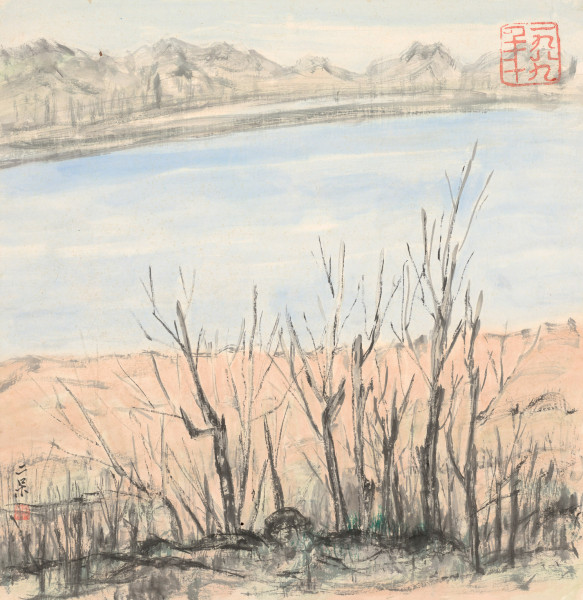
Barren Branches by the Quiet S
Ink painting
Size 67.3cmX69.2cm
Price Not Set | Contact us to inquire about artwork status and collection availability
Certificate
M2025CBP000051PA
此資產證號(M2025CBP000051PA)為登錄憑證;著作權或授權內容以另行標示為準。

Artist
Chao Er Dai
Creation Year
1989
Condition Status
無框/裸
Supplier
POST WINGS
Introduction
In this type of work, Zhao Erdai employs a compositional approach that is not based on the idealized spaces typical of traditional landscape painting. Instead, it can be defined as a "horizontally layered composition based on the viewpoint of the moment." The foreground, middle ground, and background of the image are not arranged according to the three distances method or the hierarchy of mental imagery; rather, they are directly derived from the artist's standing position and the conditions of actual observation, forming a natural hierarchy of sight.
The foreground often features a single plant or a cluster of plants, devoid of symbolic meaning or rhetorical brushwork, serving instead as a concrete marker of the artist's physical presence. The middle ground's sea or lake preserves a sense of actual distance, not transformed into a space designed to guide the gaze. The distant mountains are treated as a subtle, decentralized background presence, presenting an overall composition that reflects the perspective of onsite viewing.
This compositional method is a key characteristic brought about by Zhao Erdai's non-academic background. Unrestricted by the formal rules of traditional ink painting, he has not been constrained by the spatial paradigms of classical landscape. Instead, through long-term sketching and walking in nature, he has gradually developed a way of viewing and painting rooted in bodily experience.
Mr. Erdai's ink language does not pursue formal completion but retains the wind direction, distance, and sight height present in the natural field, resulting in a highly sincere space reminiscent of an amateur artist. Therefore, Mr. Erdai's landscape works do not strive for the grandeur, profundity, or ideal narratives of a master, but instead exhibit a pastoral quality that records the transient and equal coexistence of people and land. This non-heroic, non-academic ink creation represents a unique and elusive core value.
The foreground often features a single plant or a cluster of plants, devoid of symbolic meaning or rhetorical brushwork, serving instead as a concrete marker of the artist's physical presence. The middle ground's sea or lake preserves a sense of actual distance, not transformed into a space designed to guide the gaze. The distant mountains are treated as a subtle, decentralized background presence, presenting an overall composition that reflects the perspective of onsite viewing.
This compositional method is a key characteristic brought about by Zhao Erdai's non-academic background. Unrestricted by the formal rules of traditional ink painting, he has not been constrained by the spatial paradigms of classical landscape. Instead, through long-term sketching and walking in nature, he has gradually developed a way of viewing and painting rooted in bodily experience.
Mr. Erdai's ink language does not pursue formal completion but retains the wind direction, distance, and sight height present in the natural field, resulting in a highly sincere space reminiscent of an amateur artist. Therefore, Mr. Erdai's landscape works do not strive for the grandeur, profundity, or ideal narratives of a master, but instead exhibit a pastoral quality that records the transient and equal coexistence of people and land. This non-heroic, non-academic ink creation represents a unique and elusive core value.
Video Intro
None
Exhibition Resume