Collect
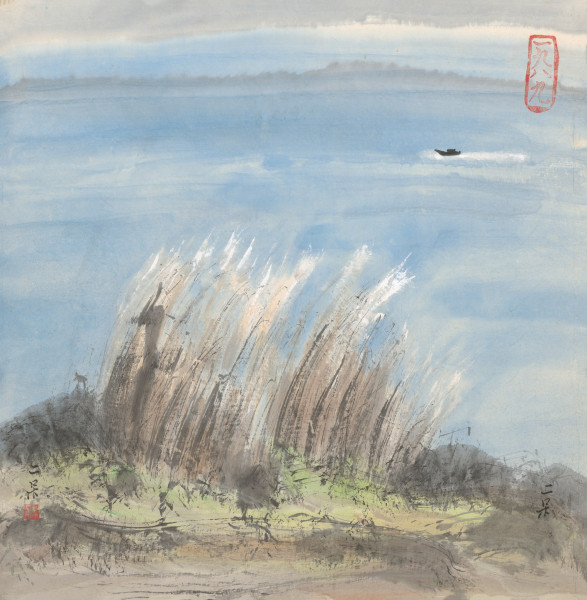
Silent Wind Grass
Ink painting
Size 68cmx69.4cm
Price Not Set | Contact us to inquire about artwork status and collection availability
Certificate
M2025CBP000050PA
此資產證號(M2025CBP000050PA)為登錄憑證;著作權或授權內容以另行標示為準。

Artist
Chao Er Dai
Creation Year
1989
Condition Status
未裱
Supplier
POST WINGS
Introduction
This work was completed when Zhao Erdai was seventy-two years old, marking one of his important late-life creations in the style of "sketching with ink wash." The scene is set on the basalt coastline of Penghu, where a solitary boat slowly sails across the distant sea, while the foreground features a clump of reeds swaying and inclining in the strong wind.
At this stage of creation, Zhao Erdai no longer responds to the world with a critical or dialectical stance but instead shifts towards an almost silent observation. Ink wash here does not serve as a tool for emotional projection but becomes a medium that carries a sense of time and the state of life. The reeds in the painting are not symbolic decorations but rather a natural existence derived from on-site sketching—their tilting, disorderly form, and repetitive brushwork directly respond to the environmental conditions of the Penghu coastline, which has long been shaped by the wind.
The reeds present a strong sense of "temporality" and "fluidity," symbolizing the ever-changing state of life as time progresses; they lack a solid form yet manage to exist in the wind, much like the artist's position in the passage of time. The distant solitary boat serves as a temporal marker in the viewer's line of sight, pointing to the continuity of life's journey while also implying a state of both departure and forward movement.
The overall composition does not seek dramatic arrangement but retains the asymmetry and emptiness of on-site observation, making wind, distance, and time crucial conditions for the emergence of the painting. This work embodies the core spirit of Zhao Erdai’s late-life "sketching with ink wash"—no longer articulating the meaning of life, but allowing nature itself, in its silence, to reveal the flow and disappearance of life.
At this stage of creation, Zhao Erdai no longer responds to the world with a critical or dialectical stance but instead shifts towards an almost silent observation. Ink wash here does not serve as a tool for emotional projection but becomes a medium that carries a sense of time and the state of life. The reeds in the painting are not symbolic decorations but rather a natural existence derived from on-site sketching—their tilting, disorderly form, and repetitive brushwork directly respond to the environmental conditions of the Penghu coastline, which has long been shaped by the wind.
The reeds present a strong sense of "temporality" and "fluidity," symbolizing the ever-changing state of life as time progresses; they lack a solid form yet manage to exist in the wind, much like the artist's position in the passage of time. The distant solitary boat serves as a temporal marker in the viewer's line of sight, pointing to the continuity of life's journey while also implying a state of both departure and forward movement.
The overall composition does not seek dramatic arrangement but retains the asymmetry and emptiness of on-site observation, making wind, distance, and time crucial conditions for the emergence of the painting. This work embodies the core spirit of Zhao Erdai’s late-life "sketching with ink wash"—no longer articulating the meaning of life, but allowing nature itself, in its silence, to reveal the flow and disappearance of life.
Video Intro
None
Exhibition Resume