Collect
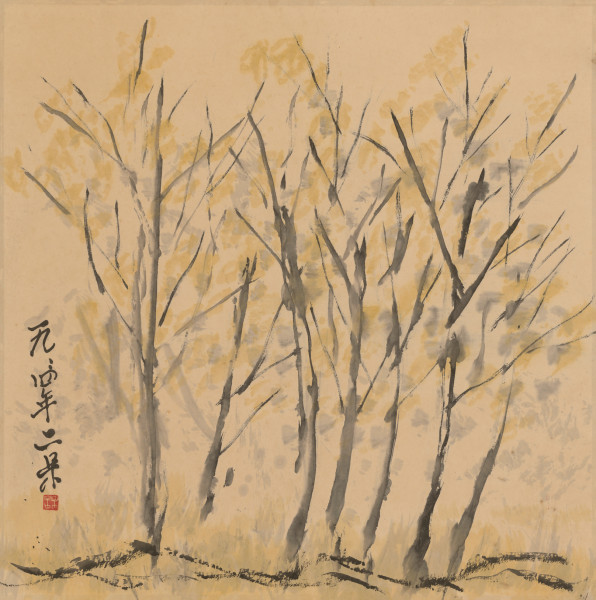
Calm Wind in the Blue Forest
Ink painting
Size 68.7cmx69.2cm
Price Not Set | Contact us to inquire about artwork status and collection availability
Certificate
M2025CBP000048PA
此資產證號(M2025CBP000048PA)為登錄憑證;著作權或授權內容以另行標示為準。

Artist
Chao Er Dai
Creation Year
1994
Condition Status
宣紙裱麟布/ 稍有泛黃 /木框
Supplier
POST WINGS
Introduction
This work was completed during the later years of Mr. Zhao Er-dai after settling in Penghu, at the age of seventy-seven. Having left the cultural center of Taipei and moved to a remote island, his creations no longer respond to the trends of the times; instead, they return to the contrast between nature and his own life.
The painting depicts the silver acacia windbreak forest in Penghu during the transition from autumn to early winter. The tree trunks are strong and slender, and the branches are stripped of excess leaves, using dry brushes and light ink to create layers that leave traces of the wind's passage. The trees do not stand in rows but each stands independently, leaning against each other while maintaining distance, presenting a state of solitude yet not isolation, silence yet not dispersal.
Zhao Er-dai’s consistent ink language becomes even more restrained and simplified here. In composition, he abandons the traditional elements of distance layers and narrative structure of landscape painting, instead using the vertical tree forms as the skeleton of the artwork, forcing the viewer's gaze to linger among the trees, experiencing the weight of wind, cold, air, and time. The light ochre background reflects both the dry light of Penghu’s autumn and symbolizes the gradual fading of the clamor of life in old age.
This work is not about depicting the beauty of the landscape, but about placing personality within the landscape. The silver acacia thrives as a windbreak, much like the artist himself, who remained steadfast throughout his life, enduring storms, with branches appearing even more resilient. It does not explicitly speak of loneliness but is filled with a sense of spirit.
"Still Wind, Blue Forest" is both the autumn woods of Penghu and a reflection of Zhao Er-dai's inner state in his later years.
The painting depicts the silver acacia windbreak forest in Penghu during the transition from autumn to early winter. The tree trunks are strong and slender, and the branches are stripped of excess leaves, using dry brushes and light ink to create layers that leave traces of the wind's passage. The trees do not stand in rows but each stands independently, leaning against each other while maintaining distance, presenting a state of solitude yet not isolation, silence yet not dispersal.
Zhao Er-dai’s consistent ink language becomes even more restrained and simplified here. In composition, he abandons the traditional elements of distance layers and narrative structure of landscape painting, instead using the vertical tree forms as the skeleton of the artwork, forcing the viewer's gaze to linger among the trees, experiencing the weight of wind, cold, air, and time. The light ochre background reflects both the dry light of Penghu’s autumn and symbolizes the gradual fading of the clamor of life in old age.
This work is not about depicting the beauty of the landscape, but about placing personality within the landscape. The silver acacia thrives as a windbreak, much like the artist himself, who remained steadfast throughout his life, enduring storms, with branches appearing even more resilient. It does not explicitly speak of loneliness but is filled with a sense of spirit.
"Still Wind, Blue Forest" is both the autumn woods of Penghu and a reflection of Zhao Er-dai's inner state in his later years.
Video Intro
None
Exhibition Resume